
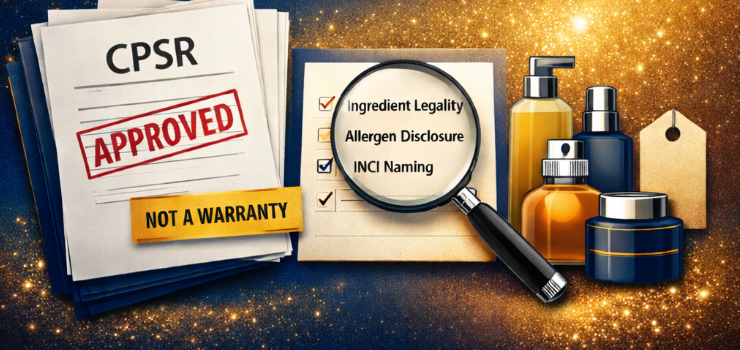
Why “CPSR Approved” Does Not Mean Your Ingredients Are Compliant in 2026
Safety snapshot vs ongoing legality and labelling control
Many teams use “CPSR approved” as a compliance green light. In 2026, that assumption is a liability.
A CPSR is a documented safety conclusion at a point in time. It is not a legal approval label. It is not a guarantee that ingredients remain permitted, labels remain correct, or packaging remains compliant as requirements change.
In 2026, compliance risk often arises without reformulation. Ingredient legal status can change, disclosure triggers can expand, and INCI naming can become mandatory, while the formula stays the same. That is how brands end up with a valid CPSR and a non-compliant product.
This article clarifies three “CPSR approved” gaps that cause 2026 non-compliance:
- ingredient legal status changes while the formula stays the same
- labelling triggers expand and the label becomes incorrect
- INCI naming updates make packaging non-compliant
Accountability point: a CPSR is not a compliance warranty. It supports a safety conclusion, but it does not override updated restrictions, labelling triggers, or mandatory nomenclature rules.
If you need a detailed reference on what a CPSR covers for EU/UK market entry, use this guide and keep this article focused on the governance gap: CPSR requirements for EU/UK market entry .
What people usually mean by “CPSR approved”
In practice, “CPSR approved” is often used to mean:
- the file exists
- the product passed a safety review once
- we did not change the formula, so there is no reason to revisit it
- we can answer audits or marketplace requests
Those statements do not equal ongoing compliance. They describe file availability, not regulatory control.
For the wider 2026 regulatory context, without duplicating it here, refer to: Why 2026 is a critical year for cosmetic compliance .
The three 2026 triggers that break the “CPSR approved = compliant” shortcut
1) Ingredient legal status changes (restriction, ban, narrower conditions)
A product can become non-compliant without reformulation if an ingredient becomes restricted, its conditions of use narrow, or its legal status changes in a way that affects your product category.
A CPSR does not “grandfather” ingredient legality. A past safety assessment does not override updated restrictions.
Methodology to manage this risk proactively: Ingredient Risk Assessment for Cosmetics (2026) .
2) Labelling triggers expand (fragrance allergens are the common failure point)
A formula can remain unchanged and still become non-compliant when disclosure lists expand and thresholds remain strict, especially when allergens are present via fragrance mixtures or essential oils.
This is where many “CPSR approved” products fail in 2026. The safety file exists, but the label becomes incorrect because the brand does not hold supplier data granular enough to calculate finished-product disclosure accurately.
Internal deep dive, so this article stays high-level: Fragrance allergen labelling under Regulation (EU) 2023/1545 .
External legal reference (EU): Regulation (EU) 2023/1545 (EUR-Lex) .
3) INCI naming becomes mandatory (packaging non-compliance)
INCI naming updates are operationally material. They affect artwork, print cycles, and packaging inventory. A product can remain safe and legally permitted, while packaging becomes incorrect.
A CPSR does not resolve packaging compliance.
Operational framework, kept in one place to avoid content overlap: Cosmetic Ingredients Compliance in the UK, EU and USA (2026 update) .
External reference (EU): Implementing Decision (EU) 2025/1175 (EUR-Lex) .
Three micro-cases: how brands get caught in 2026
Micro-case 1: No reformulation, no review, then a legality failure.
A brand keeps selling a best-seller because the formula did not change and a CPSR exists. A restriction update changes permitted conditions or limits for an ingredient used near the previous threshold. Internally the product stays “CPSR approved.” Externally it becomes a legal non-compliance exposure.
Next step:
Ingredient Risk Assessment (2026)
.
Micro-case 2: Safety file exists, but the label is wrong.
A product passes safety. The fragrance supplier provides general compliance statements. In 2026, disclosure obligations expand and the brand needs a finished-product-relevant allergen breakdown. They do not have it in time, labels are not updated, and the product becomes non-compliant on labelling, even if the safety conclusion remains unchanged.
Next step:
Regulation (EU) 2023/1545 allergen labelling deep dive
.
Micro-case 3: Safety unchanged, packaging becomes non-compliant.
Packaging stock is printed months in advance. INCI naming becomes mandatory under updated nomenclature rules. The CPSR remains valid. The packaging becomes incorrect. The result is dead stock, rushed reprints, and avoidable commercial loss.
Next step:
Ingredients Compliance (2026 update)
.
The model that removes internal ambiguity
To prevent “CPSR approved” from being misused as a compliance statement, separate three layers:
- Safety (CPSR): documented safety conclusion under declared use conditions and evidence
- Ingredient legality (ongoing): current restrictions, limits, and permitted conditions in target markets
- Operational compliance (ongoing): label accuracy, INCI naming, supplier transparency, and documentation defensibility
In 2026, many failures occur in layer 2 or 3 while teams rely on layer 1 as if it covers everything.
Minimal 2026 checklist
- Identify SKUs using ingredients near thresholds or under active restriction watch.
- Require fragrance and essential oil supplier data that supports finished-product labelling outcomes.
- Treat INCI naming changes as a controlled packaging transition (artwork, proof, print, inventory).
Extended checklist and cross-market mapping: Cosmetic Ingredients Compliance (2026 update) .
When was the last time you updated the data from your fragrance composition supplier?
For ongoing monitoring scope: Responsible Person service .
FAQ
Is a CPSR a legal approval for ongoing ingredient compliance?
No. A CPSR documents a safety conclusion based on evidence and assumptions at the time of assessment. Ingredient legality and labelling compliance must be maintained against current restrictions, disclosure triggers, and mandatory naming rules.
Can a product become non-compliant in 2026 even if the formula did not change?
Yes. Restrictions can change ingredient legal status or permitted conditions. Disclosure obligations can expand. INCI naming can become mandatory. These are compliance triggers that can apply without reformulation.
What is the fastest way to reduce 2026 compliance risk?
Treat “CPSR approved” as a safety snapshot, not a compliance warranty. Run an ingredient legality and label readiness check across your portfolio, and require supplier data that supports disclosure and documentation defensibility.