
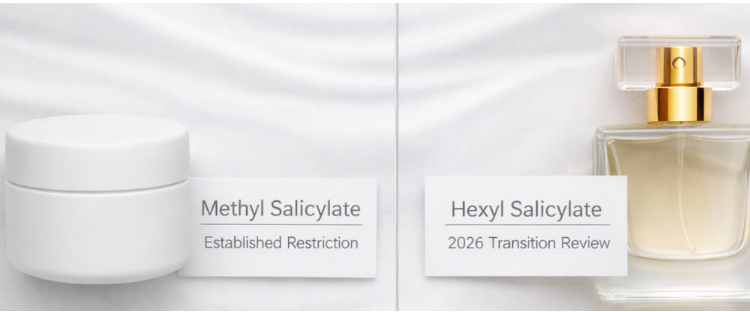
Hexyl Salicylate vs. Methyl Salicylate: Different Regulatory Pathways and Compliance Logic
Cosmetic brands should not review Hexyl Salicylate and Methyl Salicylate as if they created the same compliance task. Both substances now sit within a stricter regulatory environment following their classification as CMR category 2 (toxic for reproduction), but they do not follow the same legal timeline, the same child-exposure logic, or the same transition pattern across the EU and Great Britain.
That is why they require two different compliance review pathways, not one universal checklist. For the already established Methyl Salicylate framework, see our Detailed Guide to Methyl Salicylate in the UK/EU.
1. Methyl Salicylate is an established restriction, while Hexyl Salicylate is a live transition issue
For Methyl Salicylate, the EU framework is already established. Commission Regulation (EU) 2022/1531 added it to Annex III, entry 324, and the restriction has applied since 17 December 2022. In practical terms, that makes Methyl Salicylate a maintenance issue: teams should be checking whether existing formulas, intended-use categories, and technical documentation remain aligned with an already active rule.
Hexyl Salicylate sits in a different position. Commission Regulation (EU) 2026/78 adds Hexyl Salicylate to Annex III and applies from 1 May 2026. That makes it a transition issue rather than a maintenance issue. The compliance task is not simply to confirm what is already compliant today, but to identify affected SKUs, review formulations, assess transition windows, and make reformulation or sell-through decisions before the restriction becomes fully applicable.
2. EU and Great Britain no longer move on the same timetable
A second reason the workflows must diverge is that Great Britain does not simply mirror the EU timetable. For Methyl Salicylate, the GB restriction comes into force on 30 September 2025 under the relevant UK Statutory Instrument for Cosmetics, and products placed on the market on or before that date may continue to be made available until the end of 31 March 2026.
For Hexyl Salicylate, the EU applies the new Annex III restriction from 1 May 2026, but in Great Britain products placed on the market before 15 August 2026 may continue to be made available until the end of 14 February 2027. That difference matters operationally: the same SKU may face different decision points depending on whether you are planning for EU release, GB sell-through, or both.
3. The child-exposure logic is not the same
The scientific background also differs in an important way. For Methyl Salicylate, the SCCS scientific advice on children’s exposure concluded that, for products intended for children aged 0–3 years, the concentration should not exceed 0.4% in toothpaste and 0.02% in other products. This is scientific advice rather than a new Annex amendment by itself, but it is highly relevant to safety review and risk management for products intended for very young children.
For Hexyl Salicylate, the SCCS addendum for children aged 0–3 years concluded that the ingredient can be considered safe up to 0.1% in specified child-relevant product categories and up to 0.001% in toothpaste. The opinion also states that it is not applicable to sprayable products that may lead to lung exposure by inhalation. That means Hexyl Salicylate review must consider not only concentration, but also product type, delivery format, and intended age group.
4. The compliance workflow should be split into two separate streams
For Methyl Salicylate, the review is primarily an audit and maintenance exercise. Teams should verify the exact product category against the applicable Annex III or GB entry, confirm age grading and intended-user alignment, and check whether the same formula remains compliant across EU and GB versions of the portfolio. This is particularly important because the EU and GB restrictions are not identical, especially for certain oral-care and child-related uses.
For Hexyl Salicylate, the review is primarily a forward-looking transition exercise. Teams should identify where the ingredient appears across finished products and fragrance compounds, assess whether any affected products fall into child-relevant or sprayable categories, and map production, release, and placed-on-the-market dates against the EU and GB transition windows. In other words, the task is not just to validate a formula, but to manage a controlled regulatory transition across the portfolio.
5. Existing safety documentation may no longer be sufficient on its own
A common mistake is to assume that a previously signed CPSR or earlier safety assessment is automatically enough for ongoing compliance. When Annex entries change or new SCCS opinions alter the scientific context for exposure, child use, or product format, earlier documentation may no longer be sufficient on its own to support the product in its current market configuration under The EU Cosmetic Products Regulation (CPR).
In practice, that can affect formula review, PIF consistency, launch timing, artwork approval, and market-specific release decisions.
6. A quick comparison for regulatory teams
At a practical level, the distinction can be summarised as follows:
| Requirement | Methyl Salicylate (EU/GB) | Hexyl Salicylate (EU/GB) |
|---|---|---|
| Current status | Restricted (Annex III already active) | Transitioning to active restriction (Annex III) |
| EU deadline | Active since 17 Dec 2022 | Applies from 1 May 2026 |
| GB sell-through end | 31 Mar 2026* | 14 Feb 2027** |
| Toothpaste (0–3 years, SCCS advice) | 0.4% | 0.001% |
* for products placed on the GB market on or before 30 Sep 2025.
** for products placed on the GB market before 15 Aug 2026.
Final point
Hexyl Salicylate is not simply “another Methyl Salicylate file.” Methyl Salicylate already sits inside an established restriction and requires careful cross-market maintenance. Hexyl Salicylate is entering the restricted-use regime later and requires transition planning before the applicable deadlines in the EU and Great Britain.
If both substances appear in your range, they should be reviewed through two different compliance pathways.
<