
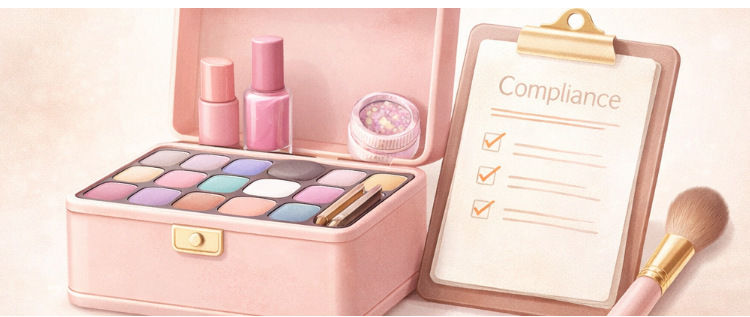
Children’s Makeup in the EU & UK: A High-Risk Product Category Most Brands Misclassify
Children’s makeup is often positioned as harmless play. From a regulatory perspective, however, it is one of the most misregulated and enforcement-sensitive product categories on the market.
Products applied to thinner, more permeable skin — often near the eyes and mouth — require stricter safety margins, more robust toxicological assessment, and correct legal classification.
Incorrect classification or inadequate safety assessment may result in product recalls, marketplace removal, or legal liability for the brand owner.
The key question for brands is not whether a product “looks safe”, but whether it is legally compliant as a cosmetic — or incorrectly treated as a toy.
Cosmetic or Toy? The Most Common Compliance Failure
One of the most critical regulatory mistakes in children’s makeup is misclassification.
Many kits are marketed under toy standards (EN 71). However, if a product is intended to be applied to the skin, it is legally classified as a cosmetic under EU Cosmetic Regulation (EC) No 1223/2009.
This means the product MUST include:
- Cosmetic Product Safety Report (CPSR) with a child-specific exposure assessment
- Product Information File (PIF)
- An appointed Responsible Person (EU/UK)
- Full ingredient compliance with Annex II, III, and IV
Misclassification creates direct enforcement risk — particularly on marketplaces such as Amazon, where missing CPSR or PIF may result in immediate listing removal.
Why Children’s Skin Changes the Risk Profile
Children are not “small adults” in toxicological assessment. Their skin physiology requires a different approach:
- Higher permeability → thinner skin barrier leads to higher absorption of substances
- Increased irritation risk → developing immune systems and skin structures are more reactive
- Lower body weight → the same dose generates significantly higher systemic exposure
This significantly affects Safety Margins (MoS) in the CPSR, making formulation control more critical than in adult cosmetics.
Ingredient Risks in Children’s Makeup
Independent testing and market surveillance repeatedly identify non-compliant substances in children’s products.
High-risk categories include:
- Heavy metals (lead, nickel, chromium)
- Mineral oil contaminants (MOAH, MOSH)
- Polycyclic aromatic hydrocarbons (PAHs)
- Allergenic fragrances and azo dyes
- Harsh surfactants such as SLS
Even trace contamination may trigger Safety Gate (RAPEX) notifications, product recalls, and regulatory action, leading to irreversible reputational damage.
Learn more about ingredient compliance requirements under EU Cosmetic Regulation.
Microplastics & Glitter: New EU Enforcement Area
Under EU Regulation 2023/2055, the use of microplastics — including traditional glitter — is being heavily restricted.
For children’s products, this creates immediate risks:
- Loose glitter may fall under restriction
- Incorrect “biodegradable” claims may trigger greenwashing issues
- Reformulation is often required to maintain market access
This is becoming an active enforcement area across EU markets.
Face Painting: Hygiene and Liability Risks
Face painting products introduce additional compliance challenges due to how they are used:
- Shared tools (sponges, brushes) → risk of microbiological cross-contamination
- Application areas → often used near sensitive eyes and lips
This increases the importance of:
- Robust preservative systems
- Microbiological quality control
- Clear and compliant instructions for use
Critical Compliance Checklist for Brands
Before launching a children’s cosmetic product, ensure you have:
- Full CPSR with child-specific exposure assessment
- Updated Product Information File (PIF)
- Responsible Person services in the EU/UK
- Ingredient verification against latest EU Annexes
- Correct classification (cosmetic vs toy)
Read more about CPSR preparation and documentation.
Key Risk: CPSR Does Not Guarantee Full Compliance
A common industry misconception is that having a signed CPSR equals total compliance.
In reality:
- CPSR is based on provided formulation data
- Incorrect raw material quality invalidates the assessment
- Contaminants are often not disclosed
This risk is significantly higher in children’s products, where safety margins are lower and tolerance for error is minimal.
Read more: CPSR approval does not guarantee full ingredient compliance.
Conclusion: A High-Liability Category
Children’s cosmetics are not low-risk “play” products.
They represent a category with:
- Increased toxicological sensitivity
- Higher enforcement exposure
- Greater reputational risk
For brands, this requires a controlled, risk-based compliance strategy from formulation to market placement.
Reduce Compliance Risk Before Market Entry
Children’s cosmetics require stricter safety validation and correct classification.
Verify your formulation, documentation, and regulatory status before launch.
Need an Ingredient-Level Risk Assessment?
If you are unsure about specific raw materials or supplier documentation: