
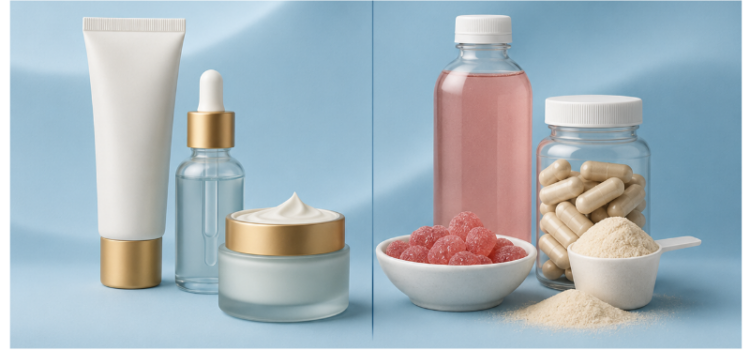
Cosmetic or Food? Why Ingestion Changes Everything
In cosmetic regulation, the line between a cosmetic product, food, food supplement and medicinal product is not a semantic detail. It is a high-stakes business decision. Classification determines the label, permitted ingredients, documentation requirements, testing costs, notification routes and legal market access.
For cosmetic brands, “beauty from within” products carry particular risk. This includes capsules, shots, powders, gummies, tablets, collagen drinks and other products that use beauty language but require ingestion. From a marketing perspective, they may look like a natural extension of a skincare range. From a regulatory perspective, they may no longer qualify as cosmetics.
Brands should start with correct product classification. In the EU, Regulation (EC) No 1223/2009 defines a cosmetic product. We also discuss the practical meaning of this definition for brands in Annel’s article What Is a Cosmetic Product? And What Definitely Is Not?.
A cosmetic product must come into contact with specific external parts of the human body, teeth or the mucous membranes of the oral cavity. It is not designed for swallowing. This means that positioning a product as “beauty”, “skin health”, “glow”, “anti-ageing” or “collagen support” does not automatically make it a cosmetic.
What matters is what the consumer does with the product, and what effect they understand from the overall product presentation.
Ingestion changes everything.
1. Cosmetics act externally. Food is ingested.
Under Article 2 of Regulation (EC) No 1223/2009, a cosmetic product must contact the external parts of the human body, teeth or the mucous membranes of the oral cavity. Its main purpose should be cleaning, perfuming, changing appearance, protecting, keeping in good condition or correcting body odours.
This makes the route of administration one of the most important classification signals. A cream, serum, balm, shampoo, toothpaste or mouth spray may fall within the cosmetic category if it meets the legal definition. A capsule, tablet, dissolvable powder, shot or drink intended for swallowing falls outside the basic logic of cosmetic regulation.
The European Commission’s materials on borderline products make clear that brands must assess borderline products case by case. The assessment should consider all characteristics of the specific product. These include formulation, instructions for use, presentation, claims and actual intended use.
In practice, the question is not only: “Does this product relate to the skin?” The better question is: “Is this product applied to the skin, or is it intended to work after ingestion?” That difference changes everything.
2. Cosmetic vs food supplement: a quick comparison
| Feature | Cosmetic product | Food supplement / food |
|---|---|---|
| Route of use | External contact: skin, hair, nails, lips, teeth or oral mucous membranes. | Ingestion; the product enters the digestive system. |
| Main function | Cleaning, perfuming, protecting, keeping in good condition, changing appearance or correcting body odour. | Supplementing the normal diet or providing nutrients or other substances with nutritional or physiological effect. |
| Typical formats | Cream, serum, balm, shampoo, toothpaste, mouth spray. | Capsule, tablet, lozenge, gummy, powder, shot, drink, sachet. |
| Main documentation | CPSR, PIF, cosmetic label, CPNP notification for the EU or SCPN notification for Great Britain. | Composition, food safety, labelling, nutrition or health claim documentation and, where required, notification to the relevant national competent authority. |
| Claims | Claims about appearance, condition, comfort or cosmetic effect, in line with Regulation 1223/2009 and Regulation 655/2013. | Nutrition or health claims that follow Regulation 1924/2006 and the conditions of use for the relevant ingredient. |
| Main borderline risk | The claim may push the product towards a medicinal product if it suggests treatment or a significant effect on physiological functions. | A beauty claim may fall outside authorised health claims or suggest medicinal action. |
This comparison is a practical editorial guide. It does not replace market-specific legal review.
This table shows the key point. Although a cosmetic and a food supplement may both speak the language of beauty, they do not sit within the same legal framework. Therefore, if the product is swallowed, a cosmetic-sounding promise is not enough.
3. Food vs food supplement: why the distinction matters
Every food supplement is food, but not every food is a food supplement. This distinction matters for “beauty from within” products.
A standard food product may be a drink, bar, powder or other edible product. A food supplement is a specific category of food intended to supplement the normal diet. It usually appears in a concentrated, dose form, for example as a capsule, tablet, lozenge, sachet, liquid ampoule or drops.
In the EU, the key legal act for food supplements is Directive 2002/46/EC on food supplements. Food law regulates food supplements, but their form, composition and presentation may trigger additional requirements, including national notification requirements.
Brands should not assess a capsule “for hair, skin and nails”, a collagen shot or a gummy “for glowing skin” as a cosmetic just because the promise relates to appearance. If the product is intended for ingestion, food law comes first. In many cases, specific food supplement requirements will also apply.
4. Mouth spray, lozenge, capsule: similar promise, different legal route
For example, oral-care products show how narrow the classification line can be.
A mouth spray intended to freshen breath and contact the mucous membranes of the oral cavity may be a cosmetic, provided the brand does not intend consumers to swallow it and the product meets the cosmetic definition.
A breath-freshening tablet, lozenge or gummy that dissolves in the mouth and is swallowed will instead fall under food or food supplement assessment, not cosmetic assessment.
Similarly, a capsule “for beautiful skin”, collagen drink or powder “for hair, skin and nails” may use beauty language, but the regulatory route is not cosmetic. The product follows the logic of food law, including requirements on safety, composition, labelling, and nutrition or health claims.
That is why, in “beauty from within” projects, brands cannot rely solely on cosmetic documentation. A Cosmetic Product Safety Report and Product Information File are essential for cosmetics in the EU and UK, but they do not make an ingestible product legally cosmetic.
5. Claims: “glow” may sound cosmetic, but ingestion triggers different rules
For cosmetic products, claims must comply with Article 20 of Regulation (EC) No 1223/2009 and with Regulation (EU) No 655/2013, which sets common criteria for cosmetic claims. In practice, a cosmetic product may refer to the appearance, condition, comfort, smoothness or hydration of the skin. The brand must keep the claim truthful, fair and supported by appropriate evidence.
For an ingested product, the reference point is different. Nutrition and health claims made on foods in the EU must follow Regulation (EC) No 1924/2006. Marketing teams cannot create claims only from a trend, supplier narrative or general ingredient popularity.
If an ingested product communicates an effect on skin, hair, nails, collagen, elasticity, ageing, cell protection or body functions, the brand must check four points. Is the claim authorised? Does it apply to the correct ingredient? Are the conditions of use met? Does the claim risk entering medicinal territory?
A useful reference point is the EU Register of Nutrition and Health Claims, which includes authorised and non-authorised claims. EFSA also publishes materials on the scientific evaluation of health claims. These materials show that food claims require a different evidential approach from cosmetic claims.
This is where many “beauty from within” products run into difficulty. A claim that sounds attractive in cosmetic brand language may not qualify as a permitted health claim for food.
6. Claim examples: cosmetic vs ingested product
Cosmetic claim: “Helps the skin look more radiant.”
Why it may be cosmetic: It refers to the appearance of the skin. An application study or consumer perception assessment may support it, provided the product is applied externally and meets the cosmetic definition.
Risk for an ingested product: If the brand promises the same effect after swallowing a capsule or drinking a shot, the claim may require assessment under the nutrition and health claims framework.
Cosmetic claim: “Improves the appearance of fine lines.”
Why it may be cosmetic: It communicates a visual and aesthetic effect.
Risk for an ingested product: If the product is intended to work from within, the claim may suggest an effect on physiological processes linked to skin structure, ageing or collagen production.
Cosmetic claim: “Skin looks smoother and more hydrated.”
Why it may be cosmetic: It relates to the appearance and feel of the skin after cosmetic use.
Risk for an ingested product: For a supplement or drink, the brand must assess whether an authorised claim exists for the specific ingredient and whether the product meets the conditions of use.
High-risk claim: “Stimulates collagen production.”
Why it is risky: It may suggest an effect on a physiological function of the body. For a cosmetic product, it may shift the communication towards biological action. For an ingested product, it may require assessment as a health claim.
High-risk claim: “Treats acne from within.”
Why it is risky: It enters the territory of disease treatment. Such a claim may push the product outside both the cosmetic category and the standard food category. It may also trigger medicinal product classification.
Developing an ingestible beauty product?
Developing a collagen drink, beauty gummy, ingestible powder or “hair, skin and nails” supplement? Before claims shape your testing plan, packaging and launch timeline, confirm whether the product belongs in the cosmetic route, the food supplement route, or another regulatory category.
7. An ingredient safe for skin is not automatically safe to ingest
One of the most common mistakes in “beauty from within” projects is transferring cosmetic logic to an ingested product. However, an ingredient known from cosmetics does not automatically become suitable for ingestion. As a result, the route of exposure, metabolism, dose, contact time, bioavailability and risk profile all change.
For a cosmetic product, safety assessment focuses on external application, a specific concentration and specific conditions of use. For an ingested product, safety assessment focuses on systemic exposure. These are two different toxicological questions.
That is why brands designing borderline products should carry out an ingredient risk assessment before formulation or reformulation. They should not limit that assessment to cosmetic bans and restrictions. If the product is intended for swallowing, a food or supplement assessment is needed. This should cover ingredient legality, doses, sources, purity, contaminants and conditions of use.
This is particularly important for global brands. An ingredient that works in a cosmetic product in the EU or UK may receive a very different assessment in an ingested product or on the US market. Brands planning international sales should review cosmetic ingredient compliance across the UK, EU and USA in parallel with the separate requirements that apply to ingested products.
8. Novel Food: an additional risk for innovative ingredients
For “beauty from within” products, brands need to check not only whether an ingredient looks attractive from a marketing perspective. They also need to confirm whether it has a history of safe consumption in the EU. New botanical extracts, innovative ingredient forms, new sources of active substances, microalgae, fermented ingredients or exotic raw materials may require assessment under the Novel Food rules.
In the EU, the key legal act is Regulation (EU) 2015/2283 on novel foods. Authorised novel foods appear in the Union list, which serves as a reference point for the legal use of such ingredients in foods and food supplements.
This risk is especially relevant for brands that transfer trends from cosmetics into ingested products. An ingredient recognised in skincare does not automatically have permitted status as a food or food supplement ingredient.
In practice, the brand should not only ask: “Is this ingredient popular in cosmetics?” It should also ask: “Can this ingredient be legally consumed in this form, dose and market?”
9. Dual-use: same ingredient, different classification
In borderline products, another issue is dual-use. The same ingredient or a similar composition may receive a different assessment depending on how the product is used. An oil, botanical extract or active ingredient applied to the skin may form part of a cosmetic product. A product intended for sublingual use, swallowing or physiological action requires a different analysis.
The same applies to format and presentation. A product with cosmetic-style branding, sold next to skincare and communicated with “glow” or “anti-ageing” language, may still be food or a food supplement if consumers ingest it.
Classification cannot therefore rely only on the ingredient name, brand aesthetic or retail category. The decisive factors are route of administration, intended use, claims, dose, presentation and target market.
10. USA: intended use and the risk of drug / dietary supplement classification
On the US market, intended use also drives classification. FDA explains in Is It a Cosmetic, a Drug, or Both? that a product may be a cosmetic, a drug, or both, depending on its intended use and the claims made for it.
Brands should also remember that “cosmeceutical” remains a marketing term, not a separate legal category in the United States. FDA assesses the product through intended use, meaning what the product is intended to do and what effects are communicated to the consumer.
For ingested products, dietary supplement rules may also be relevant. FDA publishes separate materials on dietary supplement labeling requirements. These materials show that dietary supplements have their own labelling and communication framework.
Therefore, a global beauty brand should not assume that one claim, one formula and one packaging strategy will work across the EU, UK and USA. Even if the communication remains within the language of beauty, the route of administration and promised effect may trigger completely different obligations.
For US brands planning to enter Europe, separating the cosmetic route from the food route is particularly important. Annel supports brands with EU and UK cosmetic compliance for US brands, but ingested products require a separate regulatory assessment because they do not follow the standard cosmetic route of CPSR, PIF and CPNP.
11. Why “nutricosmetic” does not solve the problem
Terms such as “nutricosmetic”, “cosmeceutical”, “beauty supplement” and “ingestible beauty” may help marketing teams. They do not create a separate legal category. The fact that a product sits in a beauty context does not make it a cosmetic.
A product applied externally may fall within the cosmetic framework when its main function is cosmetic improvement of appearance. However, once consumers ingest it, the brand must assess it under food or food supplement rules. In addition, any promise to treat, prevent disease or significantly affect body functions may trigger medicinal product risk.
For “beauty from within” products, the most important questions are:
- Is the product intended for ingestion?
- Does the claim describe cosmetic appearance, or does it make a health or functional claim?
- Do the target market rules permit the ingredients, doses and conditions of use for food or food supplements?
A “yes” to the first question should stop the standard cosmetic route. An aesthetic promise does not override ingestion.
12. What Regulatory Affairs should do before launch
The strongest Regulatory Affairs teams do not wait until the label correction stage. They act before the product brief, claims, formula and packaging are locked. In “cosmetic or food” projects, this timing matters. A late category change may force the brand to rebuild the entire project.
First: prepare a classification note.
Describe the product format, instructions for use, route of exposure, intended purpose, claims, target consumer and markets. Complete this analysis before deciding whether the product should follow a cosmetic, food, food supplement or other regulatory route.
Second: separate cosmetic documentation from food documentation.
For a cosmetic product, key elements include CPSR, PIF, CPNP/SCPN, cosmetic labelling and Responsible Person obligations. For an ingested product, the brand needs different evidence, labelling rules and claim assessments.
Third: check claims before testing.
If the relevant category does not permit the claim, a study designed to support that claim may become commercially useless.
Fourth: do not rely only on supplier substantiation.
Supplier documentation may help, but it does not replace assessment of the final formula, dose, method of use and target market.
Fifth: involve the Responsible Person and regulatory support early.
For cosmetic products, Responsible Person support is essential for legal placement and continued compliance in the EU and UK. For borderline products, the brand must first establish whether the product should be treated as a cosmetic at all.
Conclusion
In borderline products, the route of administration changes everything.
A cream with a claim about skin appearance may be a cosmetic. A capsule with a similar promise may be a food supplement. A collagen drink using anti-ageing language may require assessment under health claims rules. A product promising to treat a skin condition may move towards medicinal product classification.
Brands should not treat classification as a formality after creative work ends. They should make it a strategic decision before they develop claims, commission studies, print labels and build sales campaigns.
Ultimately, if the product is swallowed, it is not enough for its promise to sound cosmetic.
Ingestion changes everything.
Planning an ingestible beauty product?
Planning an ingestible beauty product, collagen supplement or “beauty from within” range? Before you finalise claims, packaging or market-entry timelines, request a borderline classification review.
Read also in our borderline classification series
- Cosmetic or Medicinal Product? Where Skincare Claims Cross the Regulatory Line
- Cosmetic or Biocide? The Risk Behind “Antibacterial”, “Antiseptic” and “Antiviral” Claims
- Cosmetic or Food? Why Ingestion Changes Everything
- Cosmetic or Toy? Children’s Make-Up, Bath Products and Play Value
- Cosmetic or General Product? False Nails, False Eyelashes and Beauty Accessories