Cosmetic or Toy? Children’s Make-Up, Bath Products and Play Value
Brands often design children’s cosmetic products to look colourful, scented, glittery, “magical” or associated with play. From a marketing perspective, this may seem natural. From a regulatory perspective, however, it creates a high-risk area.
A children’s lip gloss, make-up kit, bath bomb with a hidden figurine, colour-changing bath foam or scented product resembling sweets may not fit only into the classic cosmetic product category. Depending on its presentation, use pattern and marketing communication, it may also trigger toy safety rules, general product safety requirements or concerns linked to products that consumers may mistake for food.
In practice, the key question is not only: “Is the formula cosmetic?” The more important question is: what function does the product communicate to the consumer - cosmetic, care-related or play-related?
Play value changes everything.
1. Why is the cosmetic/toy classification so important?
In the European Union, regulators classify a cosmetic product by its place of application and its intended purpose. Under Regulation (EC) No 1223/2009, a cosmetic product is a substance or mixture intended to be placed in contact with the external parts of the human body, teeth or the mucous membranes of the oral cavity, with the exclusive or main purpose of cleaning, perfuming, changing appearance, protecting, keeping in good condition or correcting body odours.
Toy safety law, on the other hand, focuses on products that children use in play. Under the current EU toy framework, the reference point is children under 14 years of age. The new Regulation (EU) 2025/2509 on the safety of toys also refers to products intended for use in play by children under 14 years of age.
This means that a product does not have to serve only play in order to require toy safety assessment. It may have a cosmetic function and, at the same time, play value.
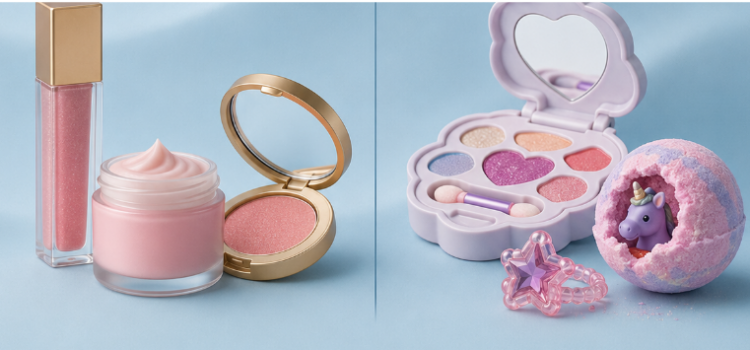
A kit for making lip gloss shows the risk clearly. The child applies the finished product to the lips, so the cosmetic element remains relevant. However, the process of mixing ingredients, the creative play instructions, child-oriented graphics and presentation as a “beauty lab” may mean that the product also requires assessment from the perspective of toy safety.
A similar risk applies to bath products. A bath bomb intended to cleanse, perfume or care for the skin may be a cosmetic product. But if the main selling point is a hidden figurine, a surprise effect, collectability or a “magical bath adventure”, the product starts moving towards the toy category.
More about the basic definition of a cosmetic product and borderline products can be found in Annel’s article What Is a Cosmetic Product? And What Definitely Is Not?.
2. Two age thresholds that do not mean the same thing: 3 years and 14 years
Brands often confuse two very different regulatory thresholds in children’s products.
For toys, the 14-year threshold matters because toy safety legislation refers to products intended for use in play by children under 14 years of age. However, this does not mean that every product for a child under 14 automatically becomes a toy. Classification depends on factors such as intended use, presentation, play function and user perception.
In cosmetics, the 3-year threshold has a different function. Regulation 1223/2009 requires a specific safety assessment for cosmetic products intended for use on children under the age of 3.
In practice, a children’s product may require assessment from several perspectives at the same time. A product for a child under 3 requires a particularly cautious cosmetic safety assessment. A product aimed at children under 14 may require an assessment of whether it has play value. A product that also looks like food may create another layer of risk: the risk of being mistaken for a food product.
3. Intended use: classification starts with presentation
In borderline products, intended use is critical. Authorities do not assess it only on the basis of what the manufacturer claims internally. Market surveillance authorities also look at how the product appears on the market and how the average consumer may understand it.
The product name, graphics, packaging shape, age group, instructions for use, marketing claims, sales channel, in-store placement and social media advertising may all be relevant. In children’s products, it is especially important to assess what behaviour the product encourages: ordinary cosmetic use or play activity.
The European Commission indicates that borderline products require a case-by-case assessment. This means that the ingredient list alone is not sufficient to determine classification. The whole product must be assessed: formula, presentation, claims, packaging and reasonably foreseeable use. The Commission provides further information on borderline products.
This is why a product with a very similar formula may have a different regulatory status depending on how the brand presents it. A lip gloss sold as a simple cosmetic product for children will create a different profile from a kit marketed as “create your own magical lip gloss and play with colours”.
4. What is play value?
Play value is the element that makes a product attractive not only because of its cosmetic function, but also as a tool for play.
It may come from role play, such as “beauty salon” or “princess make-up”, from mixing ingredients, from a hidden figurine, a colour-changing effect, toy-like packaging or wording such as “magic”, “surprise”, “collect them all” or “fun bath”.
Attractive graphics alone do not always mean that a product is a toy. However, the more play-related elements appear together, the greater the risk that authorities or platforms may treat the product as a product with dual regulatory risk.
This issue is particularly important for children’s make-up. These products are often applied around the eyes, lips and face, which are more sensitive areas. Annel discusses this topic in more detail in Children’s Makeup in the EU & UK: A High-Risk Product Category Most Brands Misclassify.
5. Cosmetic vs toy: a quick comparison
| Feature | Cosmetic product | Toy / product with play value |
|---|---|---|
| Primary logic | External application for cleaning, perfuming, protecting, keeping in good condition or changing appearance. | Use in play by children, including role play, creative activity, collection or surprise elements. |
| Typical examples | Lip balm, bath product, cream, shampoo, cosmetic make-up item. | Cosmetic play kit, make-your-own lip gloss kit, bath bomb with hidden toy, toy-like packaging. |
| Key regulatory question | Does the product meet the cosmetic definition and is it safe for the intended user? | Does the product encourage play and trigger toy safety requirements? |
| Main documentation | CPSR, PIF, cosmetic label, CPNP notification for the EU or SCPN notification for Great Britain. | Technical documentation, conformity assessment, EN 71 analysis, warnings and instructions where applicable. |
| Main borderline risk | The product may be presented in a way that creates play value or medicinal-style claims. | The product may still involve a cosmetic mixture applied to skin, lips, nails or the eye area. |
This comparison is a practical editorial guide. It does not replace market-specific legal review.
6. Cosmetic, toy or both regulatory regimes at once?
One of the most common mistakes brands make is assuming that a product must belong to only one category. In practice, a product may need assessment both as a cosmetic product and as a toy.
Brands should pay particular attention to make-your-own cosmetic kits, children’s make-up sets, bath products with surprises, fragrance kits, creative products and packaging that functions as a toy.
In the toy context, brands should pay close attention to the EN 71 series of standards. EN 71-13 is especially relevant for cosmetic toy kits, olfactory board games and gustative games. In 2025, the Commission updated references to EN 71-13:2021+A2:2024 and EN 71-3:2019+A2:2024 in an implementing decision on harmonised standards for toys. See Commission Implementing Decision (EU) 2025/2519.
This means that a “cosmetic play kit” may require not only a classic cosmetic assessment, but also an analysis of compliance with toy requirements, including chemical and mechanical safety, warnings, instructions and technical documentation.
7. Food-imitating products: when a cosmetic looks like a cupcake, sweet or drink
In children’s products, a particular risk arises when a cosmetic resembles food. This applies especially to bath bombs shaped like cupcakes, soaps resembling sweets, lip glosses in drink-like packaging, foams that look like desserts or products with intense fruit or candy scents.
Historically, this issue in the EU was regulated by Directive 87/357/EEC on products which, appearing to be other than they are, endanger the health or safety of consumers. The EU has now repealed that directive and replaced it with Regulation (EU) 2023/988 on general product safety, which repealed both Directive 2001/95/EC and Directive 87/357/EEC.
For brands, this means that “cute”, “sweet” or “dessert-inspired” aesthetics are not merely a creative decision. If a child may mistake the product for food, try to bite it, lick it or swallow a small part, the risk is no longer only cosmetic. It becomes a product safety risk.
Brands should also remember the Safety Gate system, formerly known as RAPEX. It is the EU rapid alert system for dangerous non-food products, enabling fast exchange of information on measures taken against products posing a risk.
In practice, a bath cosmetic resembling a cupcake, sweet or ice cream may become not only a classification issue, but also a public market surveillance issue. For a brand, this means the risk of withdrawal, lost sales, negative visibility in Safety Gate and reputational consequences that may be difficult to reverse.
8. Claim examples: lower-risk vs higher-risk presentation
The examples below show how marketing language can change the regulatory risk profile of a product.
| More cosmetic presentation | Higher borderline-risk presentation |
|---|---|
| “Gently cleanses the skin during bath time.” | “Turn bath time into a magical adventure with a hidden figurine.” |
| “Adds a subtle colour and shine to the lips.” | “Create your own lip gloss and play with colours.” |
| “Leaves the skin delicately scented.” | “A scented surprise to collect.” |
| “Helps keep children’s skin in good condition.” | “Beauty salon play for little stylists.” |
| “Use under adult supervision.” | “Independent play for children aged 3+.” |
| “Protects the skin from drying out.” | “Regenerates the damaged skin barrier and eliminates irritation.” |
The last example goes beyond the cosmetic/toy boundary and shows an additional risk: crossing into medicinal-style claims. Claims such as “heals”, “eliminates irritation”, “has anti-inflammatory action” or “regenerates damaged skin” may go beyond the standard cosmetic function.
In the United States, the FDA indicates that intended use may determine whether a product is a cosmetic, a drug or both. Products claiming to treat or prevent disease, or to affect the structure or function of the body, may fall under the drug regime. See FDA guidance: Is It a Cosmetic, a Drug, or Both?
9. Bath products with a surprise
Bath products are one of the most problematic categories. On one hand, they may meet the definition of a cosmetic product if their main purpose is cleansing, perfuming or caring for the skin. On the other hand, brands often design them as a play experience.
The risk increases especially when the product contains a hidden figurine, encourages collection, looks like a sweet or dessert, is marketed as “magic bath” or “surprise inside”, or leaves behind an element that the child can continue playing with after use.
In these cases, the key question is what drives the purchase: cosmetic function or play? If a parent buys the product mainly because the child wants to find a figurine or collect another character from the series, the cosmetic argument may not be enough.
Bath products for children also require a particularly careful safety assessment. A child may accidentally swallow a small amount of product, rub their eyes, use the product contrary to the instructions or play with packaging elements. If the product looks like a cupcake, sweet or dessert, accidental oral contact becomes even more foreseeable.
10. Children’s make-up: cosmetic, play product or toy cosmetic?
Children’s make-up is an especially sensitive category because it combines three elements: application to the body, play attractiveness and child exposure.
Consumers may perceive eyeshadows, lip glosses, nail polishes, face glitters or character make-up kits as cosmetics. However, if a brand sells them as creative kits, with play instructions, accessories, applicators and toy-like packaging, classification becomes more complex.
It is not enough to say: “it is only a toy” or “it is only a cosmetic”. If the product is applied to the skin, lips, nails or eye area, cosmetic requirements may still apply. If the product is also intended for play, toy safety requirements may also be relevant.
For brands, this means that the formula, application area, user age, play value, instructions for use and packaging must be assessed as one coherent risk profile.
11. EU, UK and USA: three different compliance perspectives
Children’s borderline products should be assessed separately for each market.
In the EU, Regulation 1223/2009 remains the basis for cosmetic products, while the current toy safety regime still applies to toys. The new Regulation (EU) 2025/2509 has already been published and will generally apply from 1 August 2030.
Great Britain: SCPN and toy safety
In Great Britain, cosmetic products placed on the GB market require, among other things, a responsible person and notification via SCPN. See GOV.UK cosmetic products guidance. Toys must meet the requirements of the Toys (Safety) Regulations 2011, which set out essential safety requirements for products placed on the GB market.
USA: MoCRA and intended use
In the United States, MoCRA requirements are important, including the obligation to ensure and maintain records supporting adequate safety substantiation for cosmetic products. The FDA indicates that the responsible person must maintain records supporting adequate safety substantiation for cosmetic products. See MoCRA - FDA.
More about entering the EU and UK markets can be found here: EU & UK Cosmetic Compliance for US Brands.
Launching a children’s cosmetic, bath product or play-related cosmetic kit?
Before you lock packaging, claims and the product concept, confirm whether the product follows the cosmetic route, the toy route or a dual-risk route.
12. Documentation: CPSR, PIF and toy technical documentation
Brands commonly prepare documentation for only one product category, and this creates one of the main risks in borderline products.
If a brand treats the product as a cosmetic, it usually focuses on the CPSR, PIF, label, notification and ingredients. This is necessary, but it may not be sufficient if the product also has play value.
If, on the other hand, a brand treats the product as a toy, it may ignore the fact that the mixture is applied to the child’s skin, lips or nails. This is also risky, because the cosmetic element does not disappear just because the product was packaged as a toy.
In practice, documentation should reflect the real profile of the product. For a cosmetic product, this means the CPSR, PIF, ingredient assessment, label, notification and claim substantiation. For a toy, it may mean technical documentation, conformity assessment, EN 71 analysis, age warnings, instructions and mechanical and chemical safety requirements.
For children’s products, it is particularly important that the assessment covers the finished product, not only the ingredients. Child exposure, possible contact with eyes and mouth, ingestion risk, packaging safety, small parts, fragrance allergens, colourants, preservatives, stability, microbiology and reasonably foreseeable misuse should all be considered.
More about cosmetic documentation: Cosmetic Product Safety Report (CPSR) and Product Information File (PIF).
13. Ingredients: a children’s product is not automatically a safe product
Children’s products require a more cautious ingredient assessment. Some ingredients permitted in adult cosmetics may be problematic in children’s products because of use pattern, application area, frequency of contact or reasonably foreseeable misuse.
Brands should pay particular attention to fragrance substances and allergens, colourants, preservatives, glitter and small particles, potentially irritating ingredients, CMR substances, endocrine-disrupting substances, heavy metal impurities, migration of elements from toy components and packaging material safety.
In children’s products, it is not enough to check whether an ingredient is formally allowed. The brand must also assess whether it is appropriate for the specific age group, application area and use pattern.
More about cosmetic ingredient compliance in the EU, UK and USA: Cosmetic Ingredients Compliance: UK, EU & USA.
14. The most common mistakes brands make
The greatest risk arises when the marketing and design team finalises the packaging, campaign and claims, and the regulatory team only receives the product for review just before the label goes to print. For borderline products, this is far too late.
Typical mistakes include assuming that a product is a cosmetic only because it contains a cosmetic formula, or that it is a toy only because it is aimed at children. Another common problem is failing to assess play value, using wording such as “magic”, “fun”, “play”, “surprise” or “collect”, designing packaging that resembles sweets, and overlooking ingestion risk, eye contact or choking hazards from small parts.
In documentation, errors usually appear as a lack of child-specific exposure assessment, inconsistency between the PIF, CPSR, label and advertising, and no assessment of toy requirements for creative kits.
15. How can brands reduce the risk?
The safest approach is to involve Regulatory Affairs at the product concept stage, not at the end of the process.
Before approving the product, the brand should determine whether the main function is cosmetic, whether the product encourages play, whether the packaging looks like a toy, sweet or collectible item, whether the product contains a figurine or surprise, and whether the claims focus on care or play.
It is equally important to assess whether the product may be used contrary to the instructions, whether there is a risk of swallowing the product or small parts, whether EN 71 assessment may be needed, and whether the CPSR reflects the child as the real user.
If several elements point towards a play function, the product should be analysed as a potential dual-risk product.
16. Strategic recommendations for brands
For brands planning to launch children’s cosmetics, bath products or creative kits, a staged approach is recommended.
First, classification should be established before the marketing brief is frozen. At this stage, it is easiest to adjust claims, product name, presentation or kit structure.
Second, the cosmetic function should be separated from the play function. If the product is intended to remain a cosmetic, communication should support the cosmetic definition. If the brand wants to build the product around play, it must accept the need for additional regulatory analysis.
Third, packaging should be audited before printing. Shape, colours, graphics, cartoon characters, sweet-like aesthetics and messages such as “surprise inside” may all have classification significance.
Fourth, documentation should cover the finished product, not only the ingredients. CPSR, PIF, technical documentation, label, instructions and claims must be consistent.
Fifth, compliance should be planned globally. A product sold in the EU, UK and USA may require different documentation routes, different notifications, different Responsible Person requirements and different interpretations of claims.
More about Responsible Person support can be found here: Responsible Person Services for Cosmetics in the UK, EU & USA.
Conclusion
In the children’s sector, the boundary between a cosmetic product and a toy is particularly narrow. A product may have a cosmetic formula, but its presentation, packaging and communication may give it play value. When this happens, classification becomes more complex.
Brands create the greatest risk when they treat classification as a formality at the end of the process. In reality, the “cosmetic or toy” decision should be one of the first stages of product development.
For children’s make-up, bath products, creative kits and products with surprises, INCI compliance alone is not enough. Brands need to assess intended use, presentation, claims, packaging, age group, reasonably foreseeable child behaviour and market-specific requirements together.
A well-designed regulatory strategy does not limit brand creativity. It allows that creativity to be managed in a safe, predictable and compliant way. In the children’s sector, this is especially important, because an attractive marketing concept must never override the core obligation: ensuring child safety and correct product classification.
Planning a children’s cosmetic, bath product or cosmetic toy kit?
Planning children’s make-up, a bath product with a surprise, a cosmetic play kit or another child-directed product with play value? Before you finalise claims, packaging or market-entry timelines, request a borderline classification review.
Read also in our borderline classification series
- Cosmetic or Medicinal Product? Where Skincare Claims Cross the Regulatory Line
- Cosmetic or Biocide? The Risk Behind “Antibacterial”, “Antiseptic” and “Antiviral” Claims
- Cosmetic or Food? Why Ingestion Changes Everything
- Cosmetic or Toy? Children’s Make-Up, Bath Products and Play Value
- Cosmetic or General Product? False Nails, False Eyelashes and Beauty Accessories